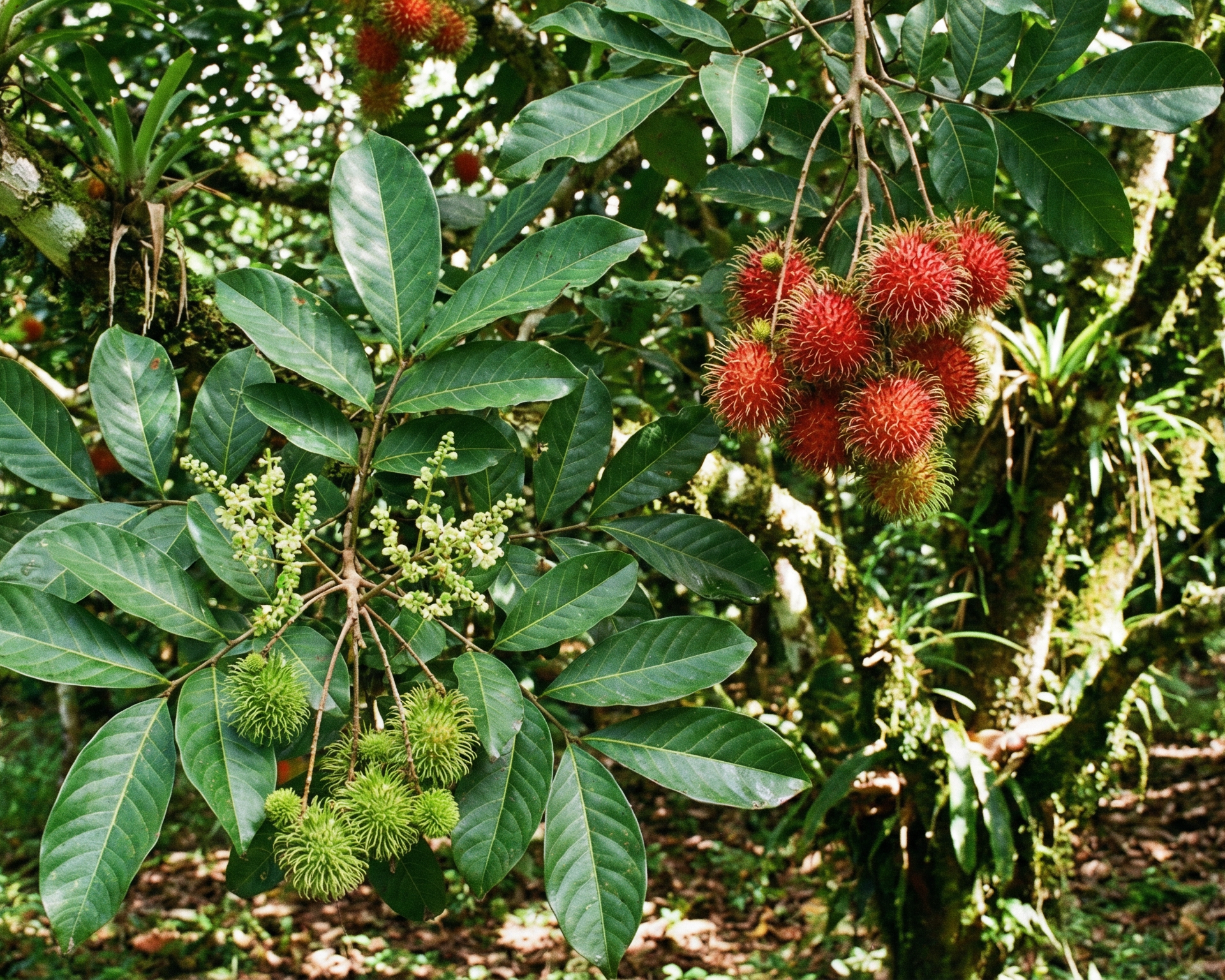
Rambutan
Nephelium lappaceum
2 nurseries nationwide
Compare nurseries
Nurseries with recorded shipping, across all locations. Confirm delivery to your address and availability on the nursery website.
No nursery options match these filters
Try another size or variety, or broaden your location. Options with unconfirmed variety names are included when All varieties is selected.
About Rambutan
Rambutan (Nephelium lappaceum) is a tropical fruit native to Southeast Asia, belonging to the Sapindaceae family, which also includes other popular fruits like lychee, longan, and pulasan. The name 'Rambutan' is derived from the Malay word 'rambut', meaning 'hair', a direct reference to the fruit's most distinct feature: a leathery, reddish skin covered in fleshy, pliable spines. This striking appearance makes the rambutan easily recognizable and a unique and popular fruit in tropical regions worldwide. The rambutan tree is an evergreen that typically grows to a height of 15 to 24 meters. It has a dense, spreading crown with alternate, pinnate leaves. The fruit itself is a round to oval drupe, borne in clusters. The hairy exterior of the fruit protects a translucent, whitish or pale pink flesh, which is both sweet and mildly acidic, often compared to the flavor of grapes. This juicy flesh, or aril, encloses a single, glossy brown seed which is not typically consumed raw due to its bitter taste and narcotic properties, but can be cooked and eaten. Rambutan is primarily consumed fresh, but it is also canned in syrup, and used to make jams and jellies. Beyond its culinary uses, various parts of the rambutan plant have been used in traditional medicine. In Malaysia, for instance, the roots have been used in a decoction to treat fever, the leaves have been used for poulticing, and the bark has been used as an astringent. The fruit is also a good source of vitamin C. Cultivating rambutan requires a warm, tropical climate with high humidity. The trees thrive in full sun and prefer well-drained, fertile loamy soils. While they can be grown from seeds, which will typically bear fruit in 5-6 years, commercial cultivation often relies on faster methods like grafting and marcotting, which can yield fruit-bearing trees in as little as 2-4 years. These methods also ensure the propagation of desirable fruit characteristics.
Plant facts
- Sun
- Full Sun
- Water
- Regular
- USDA zones
- 10-11
- Lifecycle
- Perennial
Variety guides
Explore the complete plant collection, including varieties with no nursery listings yet. Counts reflect your location and shopping filters.
- Binjai0 nurseries listed
- Deli Baling (R193)0 nurseries listed
- Deli Cheng (R170)0 nurseries listed
- Gula Batu (R3)0 nurseries listed
- Jitlee0 nurseries listed
- Lebak Bulus0 nurseries listed
- R1340 nurseries listed
- R156 (Muar Gading)0 nurseries listed
- R162 (Ong Heok)0 nurseries listed
- R167 (Chai Tow Cheng)0 nurseries listed
- R990 nurseries listed
- Rapiah0 nurseries listed
- Rongrien0 nurseries listed
- Si Chompoo0 nurseries listed
- Si Thong0 nurseries listed
- Silengkeng0 nurseries listed